
27/10/2026
28 October 1940–2026:Only the People Can Save the People, on the Path to Overthrowing Capitalism
Statements
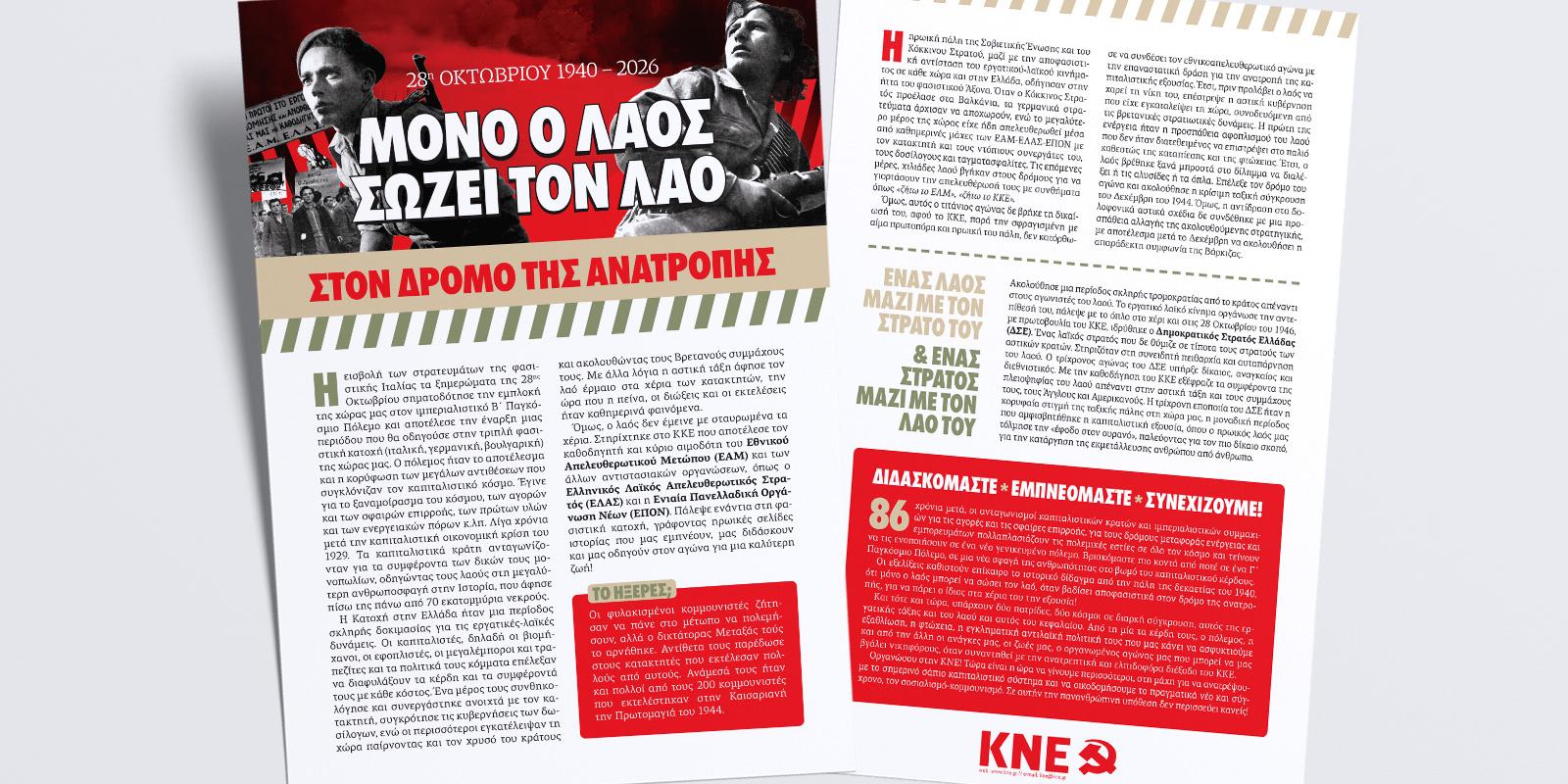
The invasion of Greece by the troops of fascist Italy at dawn on 28 October marked our country's entry into the imperialist Second World War and ushered in a period that would lead to the threefold fascist occupation of our country by Italy, Germany and Bulgaria. The war was the outcome and culmination of the major contradictions that were shaking the capitalist world. It was waged for the redivision of the world, of markets and spheres of influence, of raw materials and energy resources, etc. This came just a few years after the capitalist economic crisis of 1929. The capitalist states were competing to serve the interests of their own monopolies, leading the peoples into the greatest slaughter in history, which left more than 70 million dead.
The Occupation in Greece was a period of severe hardship for the working-class and popular forces. The capitalists—that is, the industrialists, shipowners, big merchants and bankers—and their political parties chose to safeguard their profits and interests at any cost. Some capitulated and openly collaborated with the occupiers, forming the collaborationist governments, while most fled the country, taking the state's gold with them and following their British allies. In other words, the bourgeoisie left the people at the mercy of the occupiers, at a time when hunger, persecution and executions were everyday occurrences.
Yet the people did not stand idly by. They rallied around the KKE, which was the guiding force and lifeblood of the National Liberation Front (EAM) and the other resistance organizations, such as the Greek People's Liberation Army (ELAS) and the United Panhellenic Organization of Youth (EPON). The people fought against the fascist occupation, writing heroic pages of history that inspire us, teach us and guide us in the struggle for a better life!
Did you know?
The imprisoned communists asked to be allowed to go to the front and fight, but the dictator Metaxas refused. Instead, he handed them over to the occupiers, who executed many of them. Among them were many of the 200 communists executed at Kaisariani on May Day 1944.
The heroic struggle of the Soviet Union and the Red Army, together with the decisive resistance of the workers’–people’s movement in every country, including Greece, brought about the defeat of the fascist Axis. As the Red Army advanced into the Balkans, German troops began to withdraw, while most of the country had already been liberated through the daily battles waged by EAM, ELAS and EPON against the occupiers and their local allies—the collaborationists and members of the Security Battalions. In the days that followed, thousands of people took to the streets to celebrate their liberation, chanting slogans such as ‘Long live EAM!’ and ‘Long live the KKE!’
Yet this titanic struggle was not ultimately vindicated, because the KKE, despite its pioneering and heroic struggle, sealed with blood, did not succeed in linking the national liberation struggle with revolutionary action to overthrow capitalist power. Thus, before the people had time to enjoy their victory, the bourgeois government that had abandoned the country returned, accompanied by British military forces. Its first act was to attempt to disarm the people, who were unwilling to return to the old regime of oppression and poverty. The people thus once again faced the choice between chains and arms. They chose the path of struggle, and the crucial class confrontation of December 1944 followed. However, resistance to the bourgeoisie's murderous plans was not linked to an effort to change the strategy being pursued. As a result, the unacceptable Varkiza Agreement followed the events of December.
A People with Its Army and an Army with Its People
A period of harsh state terror against the people's militants followed. The workers’–people’s movement organized its counterattack and fought with arms in hand. On 28 October 1946, on the initiative of the KKE, the Democratic Army of Greece (DSE) was founded. It was a people's army, utterly unlike the armies of the bourgeois states. It was based on the conscious discipline and self-sacrifice of the people. The DSE's three-year struggle was just, necessary and internationalist. Under the leadership of the KKE, it expressed the interests of the majority of the people against the bourgeoisie and its allies, the British and the Americans. The three-year epic struggle of the DSE marked the high point of the class struggle in our country, the only period in which capitalist power was challenged, when our heroic people dared to ‘storm heaven’, fighting for the most just cause: the abolition of the exploitation of man by man.
We Learn, We Are Inspired, We Carry On!
Eighty-six years on, competition between capitalist states and imperialist alliances over markets and spheres of influence, and over routes for transporting energy and goods, is multiplying the flashpoints of war across the world and tending to merge them into a new generalized war. We are closer than ever to a Third World War, to a new slaughter of humanity on the altar of capitalist profit.
Developments bring into sharp focus the historical lesson of the struggle of the 1940s: only the people can save the people when they resolutely take the path to overthrowing capitalist power, in order to take power into their own hands!
Then as now, there are two homelands, two worlds in constant conflict: that of the working class and the people, and that of capital. On the one hand are their profits, war, destitution, poverty and their criminal anti-people policy that is suffocating us; on the other are our needs, our lives and our organized struggle, which can lead us to victory when it joins forces with the revolutionary, hopeful way out put forward by the KKE.
Join KNE! Now is the time for more of us to join the battle to overthrow today's rotten capitalist system and build what is truly new and contemporary: socialism–communism. This is a cause for all humanity, and everyone has a part to play!