
04/10/2026
52nd Festival of KNE - "Odigitis":The main events of the 52nd KNE–“Odigitis” Festival concluded successfully
Statements
Festival
With the conclusion of the main events on Saturday 26 September, the curtain came down on the 52nd KNE–“Odigitis” Festival, after its journey across Greece and its culmination in Athens from 23 to 26 September. These four days were filled with discussions, exhibitions and historical documents, music and theatre, major tributes and concerts, books and meetings. Thousands of young people visited the areas for school and university students, young workers and women, the space for conscripts and the International City. A whole city in itself was set up and operated through the collective, voluntary work of thousands of members and friends of KNE and the KKE.
Different kinds of music, composers and artists, and people of different generations came together on its stages. Alongside them, theatre, tributes, exhibitions and books formed part of a major political and cultural gathering that did not simply invite visitors to watch, but encouraged them to search, discuss and take part.
In this way, issues that in everyday life usually appear fragmented were brought together in the same place: high prices and wages, war and armaments, work and education, history, culture and creativity, internationalist solidarity.
This was precisely what the slogan of the 52nd Festival challenged people to do from the outset: “General, man has one defect: he can think.”
To think, to ask questions, to challenge. To look behind events that seem unrelated and ask who profits and who pays.
“How much is capitalism costing us?”
This thread ran through many of the discussions during the four-day Festival and was particularly evident in Friday’s central discussion, entitled: “How much is capitalism costing us? From high prices, war and barbarity to the socialist way out.”
High prices and wages, the billions spent on military armaments and the shortages in schools and hospitals, healthcare, education, protection from natural disasters, work intensification and workplace accidents were not placed in separate “boxes”. They were linked to the same question: Who produces the wealth, where is it directed, and according to what criterion are the economy and society organized?
This question reached the central political rally as well, with the General Secretary of the CC of the KKE, Dimitris Koutsoumbas, summing it up in the phrase: “Capitalism is costing us far too much.”
“We do not work for war”
The same was true of war. It did not remain a distant piece of news or a separate issue concerning international developments. At the space for conscripts, the discussion brought to the fore Greece’s involvement in war plans, the stance of conscripts and action against the war. At the International City, 31 Communist Youth Organizations and anti-imperialist organizations brought experiences from dozens of countries, while solidarity with the peoples of Palestine and Cuba was present throughout the four-day Festival.
One of the most characteristic moments, however, brought together participants from four countries and already pointed to the next day of struggle. Dockworkers from Greece, Türkiye, Italy and France sat at the same table to discuss the strike being organized on 30 October in more than 45 ports across Europe and the Mediterranean, under the slogan “We do not work for war.” There, internationalism acquired a concrete expression in workplaces, people, a plan and a date.
History as part of the discussion about the present
A few metres away, thousands of visitors stood before the faces of the 200 communists of Kaisariani. Photographic documents from their final moments, notes and other historical material brought the younger generations face to face with a deeply moving page of history.
Together with the exhibition marking the 80th anniversary of the founding of the Democratic Army of Greece (DSE), they did not constitute a historical “interlude” from the issues being discussed about the present. In their own way, they highlighted the power of organized struggle, the glorious pages written by a heroic people when they decide to become protagonists and move history forward, when they refuse to submit to an unfavourable balance of forces. They also brought to the fore the certainty that what exists today is neither eternal nor unchangeable.
Beyond the gates
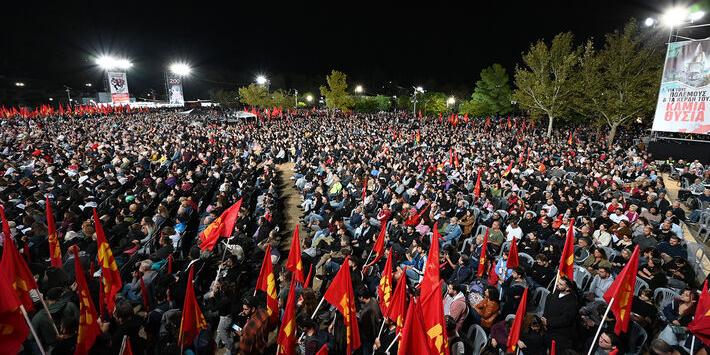
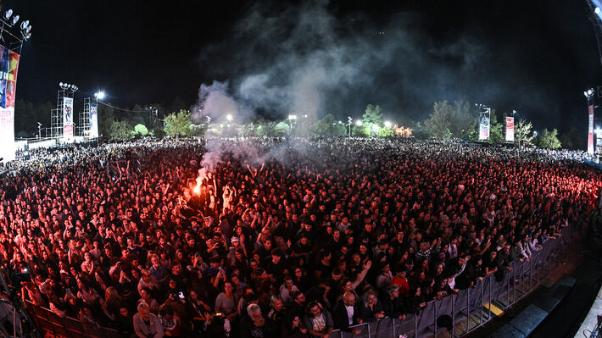
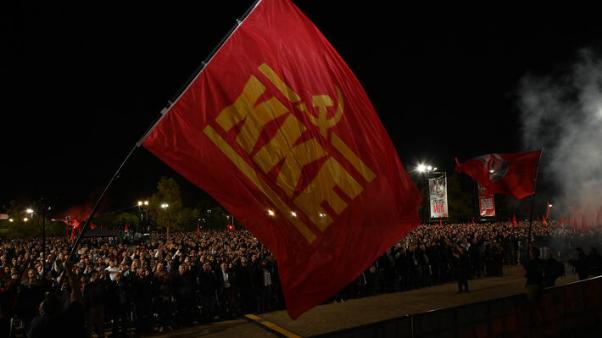
On Saturday evening, all these threads came together at the Central Stage. The pre-rally gatherings, the red flags, the international delegations and the people who, over the previous days, had filled the discussions, exhibitions and stages, all came together at the major political rally.
“We do not come here to forget the world that exists beyond these gates,” said the Secretary of the Central Council of KNE, Thodoris Kotsandis. This phrase sums up something of what the four-day Festival left behind. Because the world beyond the gates was constantly present inside the Festival: in the discussions on high prices and war, in the problems of work and education, in the concerns surrounding culture and free time, in historical experience and internationalist action.
All these threads converged in the political culmination of the Festival, with the General Secretary of the CC of the KKE, Dimitris Koutsoumbas, posing the fundamental question that ran through the four days: “Today, the question is no longer whether the world is changing, since it is changing every day anyway. The question is who will put their stamp on the direction in which this world will change.”
And it is precisely in this direction that the KKE’s proposal to today’s youth is summed up: “to live the best years of their lives”, not “in the Greece and Europe of exploitation and war”, but “in the Greece and Europe of social justice, prosperity and solidarity among the peoples; that is, in the Greece and Europe of socialism.”
