
11/12/2025
22nd Congress of the KKE: “We discuss in order to change the world”
Interview with Louiza Razou, member of the Political Bureau of the Central Committee of the KKE
Statements
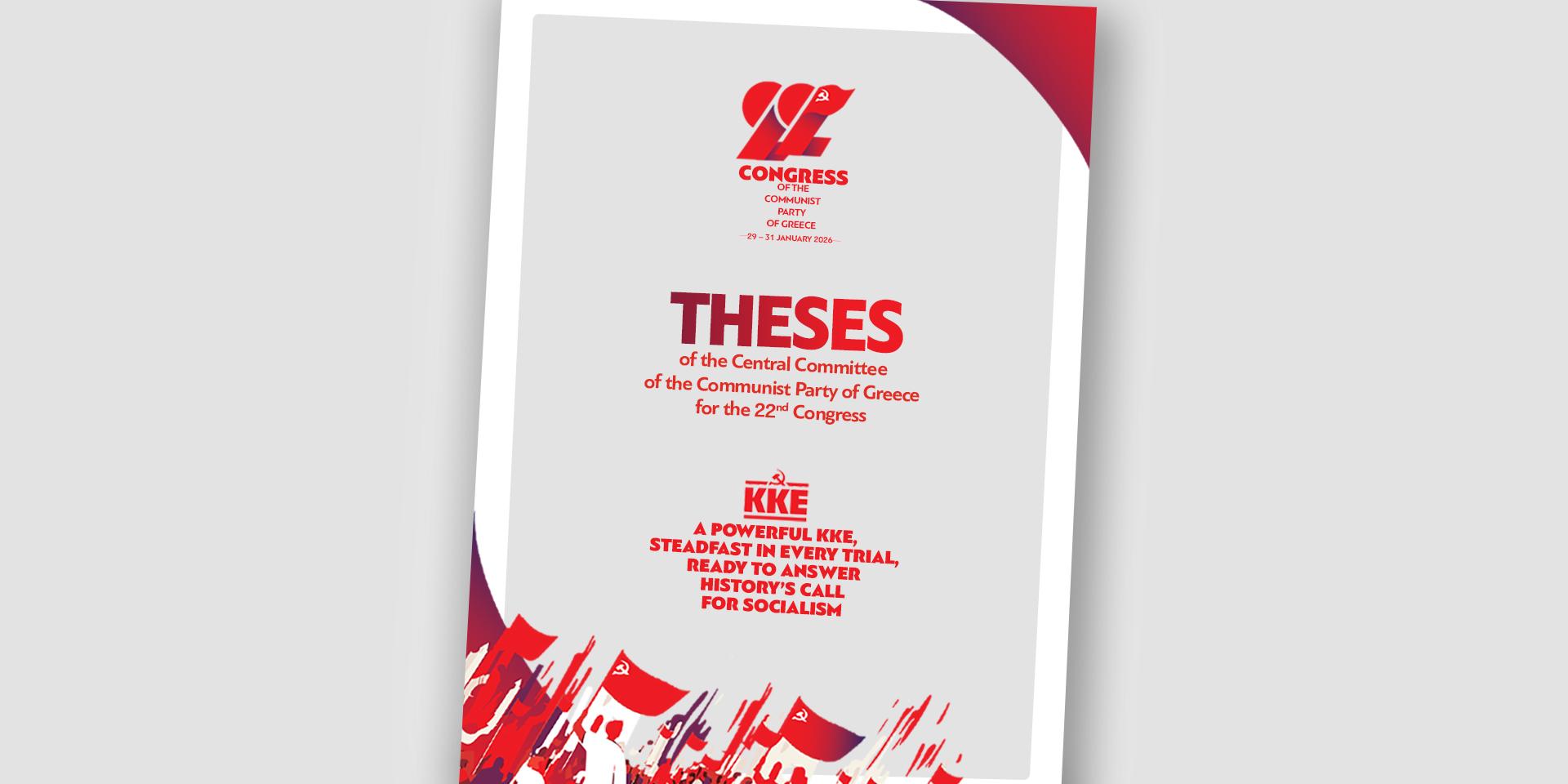
With the publication of the Theses of the Central Committee of the KKE ahead of the 22nd Congress of the KKE, Odigitis spoke with comrade Louiza Razou, member of the Political Bureau of the CC of the KKE, about what the Party Congress is, what the basic issues addressed in the Theses are, and why it is worthwhile for young people —who discuss and struggle daily together with the members of the KNE— to study them.
“Odigitis”:The 22nd Congress of the KKE will take place from 29–31 January. When many young people hear the word 'congress', they think of the infighting that takes place at the congresses of bourgeois parties. But why should young people care, and how does the KKE Congress differ?
Louiza Razou: It is likely that many young people immediately recall images from viral videos of SYRIZA's parody-like congresses held in nightclubs when they hear 'congress'. These videos show scenes of unbelievable absurdity unfolding inside and outside the halls. Or perhaps they think of the glossy congresses of ND and PASOK, which lack real discussion or delegates and are merely designed to glorify their leaderships. Afterwards, 'members of the day', who paid two euros to vote, elect their leaders in nationwide ballot-box catwalks.
However, we won't waste time in Odigitis describing the degeneration of the internal procedures of bourgeois parties. These parties and their youth organisations — those that still exist — function as 'incubators' for climbing the party hierarchy, managing bourgeois governmental power, and serving the interests of capital. This is why their congresses are often conducted on the basis of factional and fan-club criteria, turning into arenas of bargaining and personal rivalries.
In contrast, the Congress of the KKE, both in terms of process and substance, focuses on evaluating the Party's activity, drawing conclusions, and developing strategies to strengthen its fight against the capitalist system. This will enable the working class and its social allies to lead and triumph over the bourgeois class, establish their own power, and build a new socialist-communist society.
From this standpoint, Congresses of the KKE have always played a key role in developing its revolutionary strategy. They are an ongoing process in which all Party members — as well as members of KNE — are both entitled and obliged to participate. They express their opinions, thoughts and proposals and vote on the theses put forward by the Central Committee (CC) for discussion. A public pre-Congress debate is also organised in the Party's printed media. The leading organs, centred on the Party Base Organisation (PBO) in each sector, branch and region, monitor, organise and complete this entire process. Sectoral and Regional Conferences are organised and composed of elected delegates who discuss and make decisions in their field of responsibility, and who elect new leading organs.
Delegates to the Congress are also elected from the Regional Conferences on the basis of a unified nationwide criterion. These delegates form the Congress, which makes decisions and elects the new Central Committee — the Party's highest leading organ between Congresses. The corresponding organ in the KNE is the Central Council. This process reflects the revolutionary nature of the Party and cannot be compared with the procedures of other parties. We discuss in order to change the world, whereas they only care about serving the rotten, exploitative world order.
Every young man and woman who refuses to accept today's reality — this system of barbarity and oppression, of crises, wars, refugee flows and dehumanisation — surely has reason to be concerned with the Theses and assessments of the KKE. The KKE is a Party of revolutionary social change, founded on the ideology of Marxism–Leninism. It interprets the movement of human history and socio-economic systems through this worldview, which is in confrontation with irrationalism, metaphysics, and anti-scientific theories. These ultimately converge on utopian notions about 'humanising' capitalism in order to preserve it.
“Odigitis”: The Central Committee's theses for the Congress have already been published. What are the main focal points of this material?
L. Razou: 'The Theses summarise the Party's experience over the last four years and set out the direction for the next period. They emphasise our ideological and political work, our responsibilities, and the work carried out in the labour and trade union movements, among young people and women, and within our People's Alliance and all other areas in which communists are active.
The first major axis concerns international developments and the intensification of imperialist rivalries. The tendency towards a more generalised imperialist war is becoming increasingly apparent. It is not simply a matter of local conflicts; rather, it is the intensification of the old contradictions of the capitalist system and the competition between multinational monopolies and imperialist states for markets, raw materials, transport routes and geopolitical control. The Theses emphasise that the international communist movement still faces serious difficulties in forming a unified revolutionary pole. This makes our party's ongoing efforts to regroup the international communist movement on a Marxist–Leninist revolutionary basis all the more important.
A second crucial axis is domestic developments in Greece, such as the operation of capital, the course of the Greek economy, its position in the imperialist system and the policies of bourgeois governments. The Theses demonstrate that all bourgeois parties, regardless of their particular ideology, are united in their support for capitalist profitability, their intensification of exploitation and their strengthening of Greece's participation in imperialist plans and alliances such as NATO and the EU.
A third axis is the course of the class struggle and the situation of the working class, youth and women, as well as the existing dynamics. Particular emphasis is placed on the struggles that broke out during this period, such as the great uprising following the crime in Tempe, the mobilisations of students and pupils, and the struggles of workers in many sectors. These all demonstrate that there is significant potential for resistance and contestation below the surface. At the same time, the Theses highlight the obstacles caused by employer and government intervention and the role of compromised trade union leaderships in GSEE and ADEDY, as well as the general correlation of forces.
A fourth central axis is an examination of the Party's own work, including the operation of Party Organisations, ideological level, political intervention, organisational tasks, collective functioning, and leadership. Particular importance is given to the role of the KNE, its activities and the experience gained in schools, universities, workplaces and neighbourhoods.
Finally, the Theses clarify the nature of our era and emphasise the urgency and necessity of a socialist revolution. They defend the scientific principles of socialist development from the 20^(th) century, draw conclusions from the counter-revolution and overthrow in the USSR and other socialist countries, and reaffirm that socialism–communism is humanity's only hope.
These axes form an integrated whole: we do not study developments academically, but rather to prepare the Party and the working class for the great tasks ahead.
“Odigitis”: We have the text of the CC's Theses for the 22nd Congress. How can they be studied and utilised most effectively?
L. Razou: 'The text of the CC Theses consists of four interlinked chapters that form an inseparable unity with the Party at its core.' As highlighted in the introduction to the theses: 'The Party, whose entire operation and the condition of its forces must be fully harmonised with a faster and more effective pace with its revolutionary Programme and Statute, must truly be an "all-weather party", a "party ready for everything"; not as a slogan or a general goal, but as an aim reflected in its daily activity and contribution, awakening working-class and popular consciousness and guiding the struggle of our people for socialism. The capacity and preparation of our Party concern strategic–programmatic readiness and current organisational policy and action under present conditions inseparably.' Starting from this critical introduction, it is important that KNE cadres and members study the Theses from beginning to end, delving as deeply as possible into this central reflection. Naturally, many cadres and KNE members may struggle with terminology, have gaps in their knowledge, or find it difficult to understand certain concepts or conclusions. They should not hesitate to ask questions in their Party Base Organisation (PBO), the organs in which they participate, or collective working groups.
At the same time, the Theses should be used to broaden individuals' knowledge and deepen their understanding of the Party’s Resolutions, its ideology and scientific methodology. This is an opportunity to enrich their personal libraries with works by Marx, Engels and Lenin, as well as publications by the Ideological Committee of the Central Council of KNE and the CC Sections on important ideological and political issues. It is also important to develop closer relationships with the Party's and KNE's printed press: Rizospastis, Odigitis and the Communist Review (KOMEP).
The pre-congress discussion should serve as a springboard for enhancing ideological and political consolidation, as well as critical thinking. After all, KNE is the Party’s 'seedbed'. Its members are in a better position to begin their Party life with more tools at their disposal, since the Party has not only withstood counter-revolutionary setbacks and the temporary defeat of socialist construction, but has also painstakingly and persistently restored its revolutionary character, developed its Programme, and drawn valuable conclusions about the course of the class struggle by critically examining its own history and the history of 20^(th)-century socialist construction.
This wealth of experience and knowledge is a significant legacy for KNE members and the new generations who have joined the Party in recent years. It provides them with the material strength and energy to write their own pages in the people’s struggle for social liberation and navigate the new revolutionary storms that lie ahead correctly.
“Odigitis”: The CC estimates that the period we are going through is characterised by rapid and complex developments, where demands are increasing in response to difficult conditions and sudden changes. What direction are these developments heading in, and what exactly must we prepare for?
L. Razou: In a world ablaze from one end to the other, where Ministries of Defence are renamed Ministries of War and attempts are made to erase entire peoples from the map — such as the Palestinian people — and where the Greek people and their children live with the daily consequences of involvement in imperialist war, consequences that affect all aspects of life, a revolutionary party like the KKE must prepare for the significant and complex tasks arising from these developments.
Our Party is not merely an observer or analyst of events. It monitors and evaluates developments, adapting its actions and policies so that the working class and youth are not immobilised. Their concern, anger and indignation must be channelled into a radical struggle against capitalism, with the aim of overthrowing the system.
The intensification of all the contradictions of the capitalist system interacting with one another can create a situation of great mass mobilisation, potentially leading to uprisings and even a revolutionary situation. This situation arises objectively and unpredictably, as the Theses of the CC highlight. However, the art of revolution is learnt and practised in non-revolutionary conditions. This depends on the ideological, political and organisational readiness and capacity of the Communist Party, requiring continuous preparation through daily intervention and struggle.
This preparation is ongoing, even though the adversary appears immovable. However, as the lyrics of Od. Ioannou beautifully set to music by the unforgettable Th. Mikroutsikos:
'There will come days, wild days, when truths will tear like bullets. And victories, holy victories, like knives, will emerge from their sheaths...'
From today and for those days to come, we need a party that is firmly established in workplaces, working-class neighbourhoods, universities and schools. It needs active members who will form and expand the struggle and political bonds among workers, smallholders in the city and countryside, working and student youth, and the children of the working classes.
“Odigitis”: What is the main issue that the CC is raising for discussion at the Congress, and why?
L. Razou: This is also the central issue of our Congress: the need for a Communist Party that is fully prepared and capable of leading the working class and popular struggle for the overthrow of capitalism and the construction of socialism, as indicated in the title of Chapter Two of the Theses.
As you will see when you study this chapter, the CC seeks to put all the questions on which the Party’s work must focus in order to meet the requirements of the current period up for discussion. We are concerned with the development of the Party and its members and cadres. We do not compromise on our weaknesses or shortcomings. With revolutionary optimism and realism, we face the difficulties arising from the negative correlation of forces within which the Party operates. We do not invoke these difficulties to justify 'low flights' or reduced effort. No — we are not a party that 'sings its own praises'. Through thorough self-criticism, we assess the state of the Party and its involvement in the working-class movement.
In the coming years, it is crucial for the Party to establish a presence among new forces in strategic workplaces where the working class confronts the machinery of capitalist exploitation. There, workers can realise that without them, nothing works: no keyboards (conventional or smart) operate, no planes take off and no infrastructure projects are built. The most combative sections of these workers must be convinced by the Party's Programme and decide to fight through the ranks of the KKE.
This is the critical issue that concerns us. We are underdeveloped in relation to our potential for this task. The Party must be strengthened, particularly in terms of its organisation. KNE must become stronger and assume its responsibilities as part of the Party, ensuring that its leadership fully corresponds to the intense ideological and political struggle to win over the minds of the youth.
This means that the Party needs to develop a long-term plan to cultivate knowledge and strength within the ranks of KNE. Its members must continuously develop ideological, political and educational competence in order to act effectively and widely among the youth.
'Odigitis': The CC highlights positive steps and weaknesses to address in the coming period. What issues stand out for KNE?
L. Razou: KNE undertakes significant struggles with tangible results. It is at the forefront of youth struggles for education and work rights, and in solidarity with the Palestinian people. It also opposes the imperialist wars waged by imperialist powers such as NATO, the USA and the EU. Its members and cadres have been at the forefront of popular rescue efforts during floods, fires and other natural disasters, demonstrating the value of popular solidarity against a hostile state and its mechanisms.'
This vanguard, militant activity must be substantially linked with the fronts of ideological struggle, such as the assimilation within KNE of all the Party’s key contemporary elaborations and our programmatic approach to the urgency and necessity of socialism–communism. The educational current within KNE must be strengthened to enable it to rise 'a head taller' in the face of the falsehoods that reactionaries seek to impose on young minds.
KNE faces these challenges daily, from school textbooks that present deprivation as an equal problem for billionaires and the unemployed, to university lecture halls that glorify NATO’s war machine and present the coercion of 13-hour workdays as a worker’s 'right'.
Knowledge is power, and when combined with revolutionary theory, it becomes a force for revolutionary change. Embraced by the wings of the Party, the youth of KNE, in their Base Organisations and collective processes, will stand firmly on their feet, just as eagles teach their young to fly high and see far!